
When Image Becomes Object
Japanese researchers have developed a projection technique that removes shadows and visual cues, making images appear as if they are part of the physical object itself.

TECH TUESDAY || 2026.03.24
A projected image is easy to spot. Because of shadowing, however subtle, the eye immediately recognizes the image as separate from the object beneath it. And the illusion breaks completely the moment something gets in the way. Walk in front of the projection, for example, and the image will appear on your body instead.
Researchers in Japan have now taken a step toward removing these telltale cues. By projecting the same image from many directions at once, they created a system in which shadows largely disappear, allowing images to appear as if they are embedded in the object itself rather than cast upon it.
In essence, the object upon which the image is projected can appear somewhat like a video display. While this can make for more stunning projections on the side of a building or in a museum, the technology could also aid doctors during surgery.
The work, led by a team of researchers from Osaka University, is described in a study posted to the arXiv preprint server and slated for publication in IEEE Transactions on Visualization and Computer Graphics.
Beyond a Shadow of a Doubt
Projected images are everywhere. Movies on a screen, slides in a conference room, light-based displays in museums, and elaborate projection mapping on buildings all rely on the same basic idea: shine light onto a surface to create an image.
The technique has grown increasingly sophisticated. In cities around the world, entire facades are transformed with light, turning flat walls into moving scenes. In retail and exhibitions, products are overlaid with changing colors or information. In entertainment and art, a face can be made to appear older, younger, or differently textured.
Yet all of these share a common limitation. No matter how sharp or well-aligned the image is, it still looks projected. The brightness shifts depending on the surface. The image appears to sit on top of the object rather than belong to it.
The brain picks up on shadowing cues instantly. It recognizes that the light is coming from an external source, not from the object itself. A painted surface or a printed design seems to carry its color inherently. A projection, by contrast, feels like something laid over reality.
The Osaka University researchers approached the perception problem by removing the shadow clue. Instead of relying on a single projector, they used many, each casting the same image from a different angle. When an object blocks one beam, others continue to illuminate the surface, preventing a shadow from forming.
In laboratory demonstrations, the researchers showed that when an object is illuminated from multiple angles simultaneously, interruptions in any single beam are compensated by others, preserving the image and maintaining the illusion. Rather than seeing light cast onto a surface, viewers were more likely to interpret the image as part of the object itself.
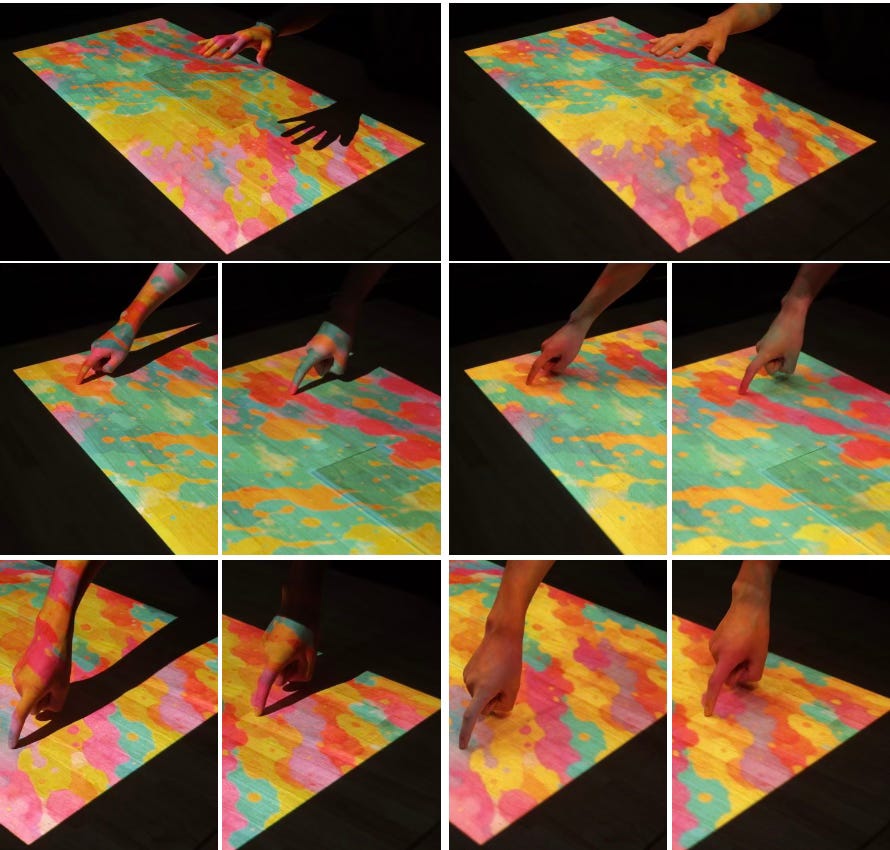
Although still a prototype, the technology may have a broad range of applications.
In industrial settings, for example, instructions could be projected directly onto machinery or components, appearing as if they are printed on the surface. A worker assembling a device might see exactly where a part should go without shifting attention to a separate screen. The worker’s hand would not cast a shadow on the object below.
Similarly, in a surgical setting, a tumor identified in a scan could be projected directly onto a patient’s body, appearing exactly where it lies beneath the surface rather than on a separate screen above the patient. Instead of shifting their gaze back and forth and mentally translating what they see, a surgeon could view the information in place, aligned with the body itself.
The technology could also extend to museums, exhibitions, and retail displays, where objects might be augmented with information or visual changes without altering the object itself. A static artifact could appear to change over time, or a product could display features dynamically.
Unlike video displays, which require dedicated hardware for each surface, projection can be applied to ordinary objects without altering them. In this way, projection may be a more practical and less expensive way to add dynamic visual information.
--
Editor’s note: The research team includes Takahiro Okamoto, Masaki Takeuchi, Masataka Sawayama, and Daisuke Iwai. Be sure to watch the video below.
More Information:
Journal Article (preprint): Iwasaki, Kensuke, et al. "Shadowless Projection Mapping for Tabletop Workspaces with Synthetic Aperture Projector." IEEE Transactions on Visualization and Computer Graphics, 18 Mar. 2026, https://doi.org/10.48550/arXiv.2603.11551
Funding Sources: JSPS KAKENHI and JST ASPIRE
Video from the Research Team: “Shadowless Projection Mapping for Tabletop Workspaceswith Synthetic Aperture Projector”