

PHYSICS & ASTRONOMY FRIDAY || 2026.08.14
It is often said that we know more about the chemical composition of stars millions of light-years away than we do about the composition of a child’s tear. There’s absolutely no truth to that silly, sentimental statement, and whoever is saying it should stop.
More defensibly, however, you could say we know more about the chemical composition of those dreamily distant stars than we do about the composition of our own upper atmosphere.
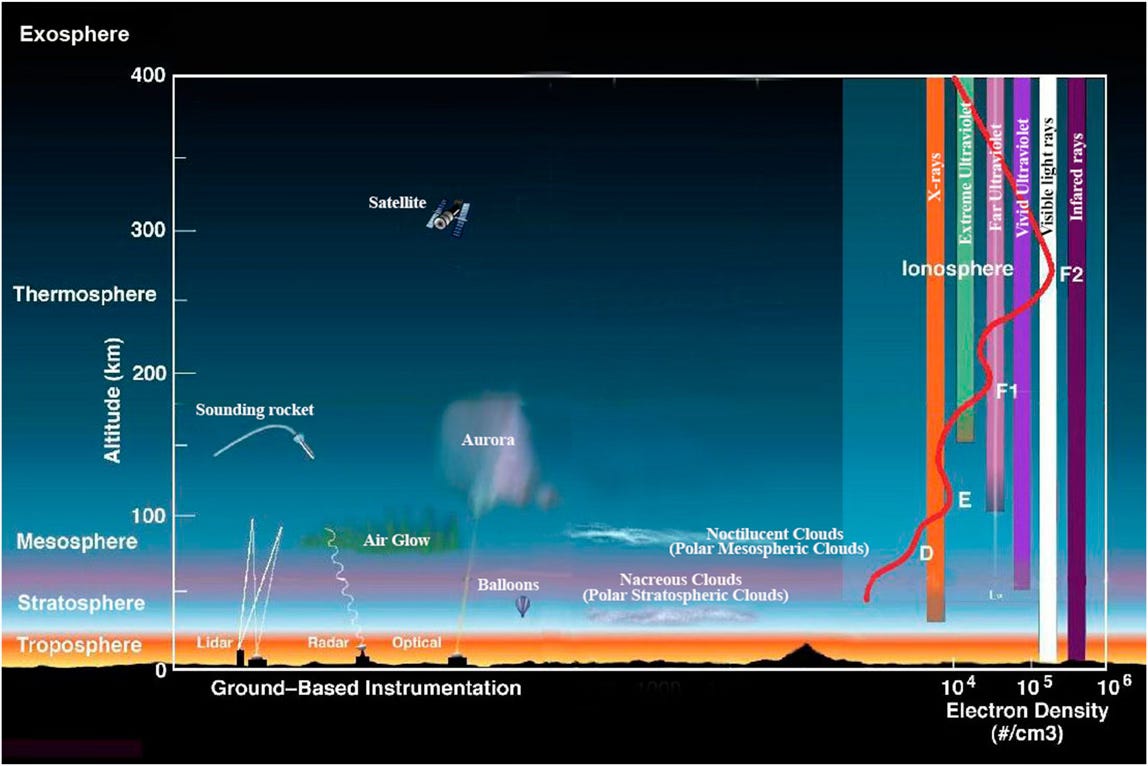
The thermosphere, as it is called, occupies an awkward observational regime. It’s far too high for conventional aircraft and weather balloons to probe. And unlike the ionosphere with which it overlaps, its predominantly neutral gas doesn’t conveniently announce itself through effects on radio signals.
But now Japanese astronomers are about to change that, tapping into data from the Starlink satellite system—only not in a way ever imagined for these satellites.
Like many satellites, Starlinks keep slipping out of orbit and, if not properly maintained, would eventually rain down on the Earth. They are being tugged down by the residual atmospheric gases in the thermosphere. The degree of this tugging is well understood and documented by the keepers of said satellites because it means the difference between a functional multimillion dollar piece of technology and a cloud of vaporized metal lower down in the mesosphere and stratosphere.
This fact gave researchers at Kyoto University an idea: They realized they could devise a way to use publicly available Starlink satellite data about this orbital decline to create a two-dimensional snapshot of thermospheric density at an altitude of 500 kilometers. After all, atmospheric density correlates with drag. And, to the angst of some, these Starlink satellites are everywhere up there. Angst, in this example, correlates with an abundance of free data.
It was a proof-of-concept study, and it worked smashingly well. The Kyoto University team’s preliminary analysis of this approach appears in the journal Earth Planets and Space.
Into the ether
The thermosphere occupies the upper-most reaches of our atmosphere, where lingering whispers of earthly molecules give way to the vast emptiness of space. This is a temperature-defined atmospheric layer, extending roughly from 100 to 1,000 kilometers above Earth. More than 99% of this region comprises neutral gas, meaning atoms and molecules with no net electric charge.
If more of that gas were ionized into electrically charged particles, positive or negative, scientists would have a much easier time detecting it. Free electrons and ions interact with radio waves, allowing researchers to probe their abundance and distribution remotely.
But what little gas that’s there—primarily of atomic oxygen at the altitudes relevant to this study, along with helium, nitrogen, and some other gases—is considerably more elusive. We know it’s there mostly because satellites feel it. Collisions with these exceedingly sparse atoms and molecules create drag, nipping away at the energy of orbiting satellites.
The research team, led by Mamoru Yamamoto of Kyoto University, used publicly available orbital data from Starlink satellites to apply tomography, a common technique in medical imaging. By calculating the orbital energy lost to atmospheric drag, the researchers were able to estimate the thermospheric density surrounding roughly 1,200 satellites.
Yamamoto described this as a “multidisciplinary study between space science and space engineering.”
Talk about a drag
The approach allowed the team to develop a snapshot of thermospheric density at an altitude of about 500 kilometers. They reconstructed densities on the order of trillionths of a kilogram per cubic meter, varying with location and time of day. Even down to 300 kilometers above Earth, the atmosphere is only about one fifty-billionth as dense as it is at the surface. Yet, remarkably, even that wisp of gas is enough to drag on satellites.
To test their results, they compared their Starlink-derived map with measurements from the European Space Agency’s Swarm satellites. Swarm is a three-satellite scientific mission launched primarily to study Earth’s magnetic field. Yet in doing do, it can also measure atmospheric drag and thus provide estimates of thermospheric density. The Kyoto team’s reconstruction agreed closely with those independent measurements, averaging about 95% of those values.
But whereas the Swarm data provide measurements along the narrow orbital paths traveled by three satellites, the Starlink-derived data can provide a broad two-dimensional map assembled from the paths of roughly 1,200 satellites.
With this proof of concept accomplished, the researchers next hope to increase the resolution of their maps, incorporate additional Starlink orbital shells at different altitudes, and eventually develop near-real-time monitoring of thermospheric density.
Yamamoto sees additional benefits to his team’s work. He said the methods the team used might also strengthen space-weather forecasting and help to make future space operations safer and more reliable.
More Information:
Journal Article (open-access): Yamamoto, Mamoru. "Tomography of Thermospheric Density from Starlink Ephemeris: Initial Report." Earth, Planets and Space, vol. 78, 2026, p. 175, https://doi.org/10.1186/s40623-026-02509-5
Founding Source: JSPS KAKENHI
Related Video: “Neil deGrasse Tyson Teaches You About the Layers of Our Atmosphere”